
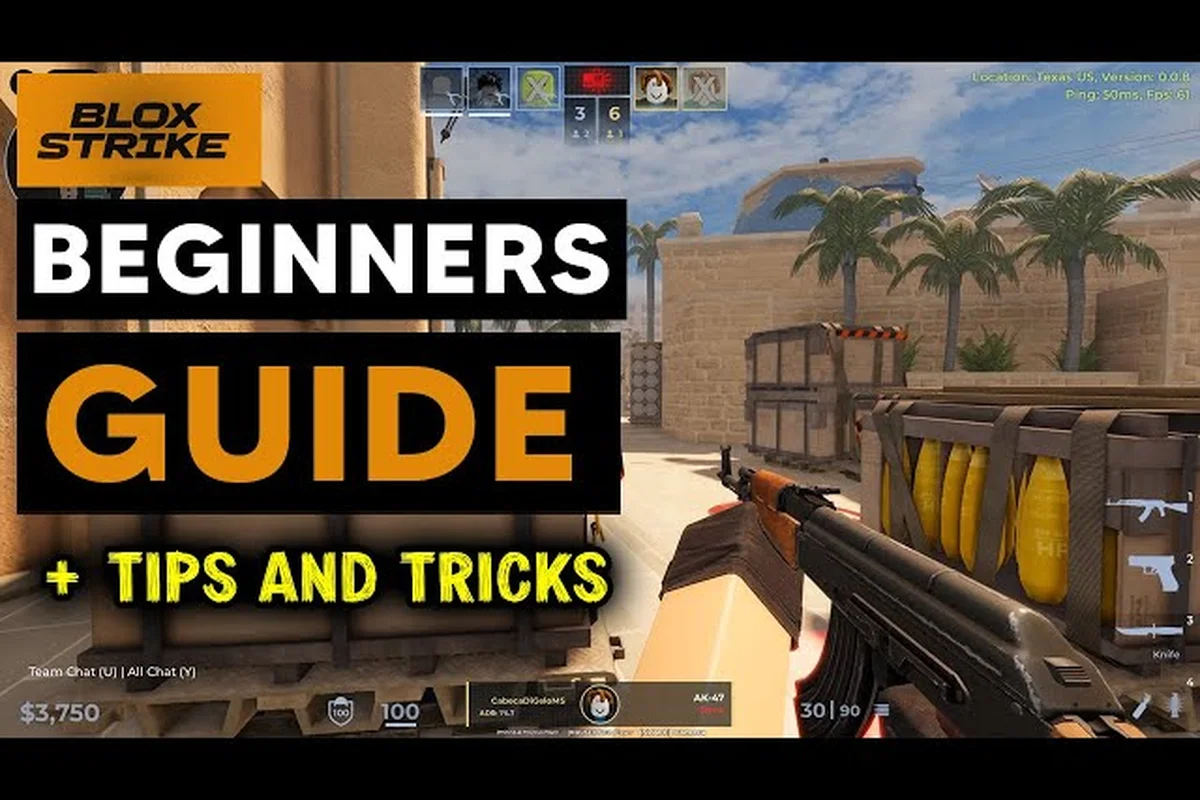
Stepping into BloxStrike for the first time can feel overwhelming because the game crams an entire tactical shooter economy, objective loop, and skin trading layer into a single Roblox experience. This BloxStrike beginner guide breaks down the 5v5 round structure, explains how attackers plant while defenders defuse, and shows how the round-by-round cash system shapes every weapon buy. New players who read through the full guide before queuing ranked will save dozens of hours of trial-and-error and avoid the most common early pitfalls, from wasted Credits to misconfigured crosshairs.
For real-time updates, patch notes, and announcements straight from the team, the official BloxStrike X account is the best place to follow along.
Understanding the 5v5 Round Format and Objective Loop
BloxStrike is a competitive 5v5 tactical shooter built inside Roblox, where one team attacks and tries to plant a bomb while the other defends and tries to hold or defuse. According to the official Roblox game page, attackers win rounds by detonating the objective and defenders win by eliminating the attackers, defusing in time, or running the clock out. The match itself is split into two halves with sides switching, mirroring the classic tactical shooter template that most Roblox players already recognize from CS-style experiences.
How Attackers Plant and Defenders Defuse
Every round in BloxStrike has a strict timer and a clear objective. Attackers must push onto a site, plant the bomb at a designated zone, and then either guard it until detonation or win the resulting post-plant fight. Defenders hold angles, delay the plant, and once the bomb is down they must retake the site and begin the defuse before the timer expires. A team that fully understands the difference between a pre-plant and a post-plant round will make dramatically better buy decisions, because winning a post-plant gunfight almost always means the round is sealed.
Sides Switch at Halftime
After the first half ends, sides swap, so the team that attacked now defends. The economy system does not reset between halves, which means the cash carried from late first-half rounds can snowball into a second-half weapon advantage. Community data from r/bloxstrike suggests that many lower-rank teams lose the second half because they treat the side switch as a clean slate rather than a continuation of an ongoing economic game. Playing the same disciplined money rules across both halves is one of the easiest ways for a beginner to look noticeably smarter than their rank.
How the BloxStrike Economy Shapes Every Buy
BloxStrike runs on a round-by-round cash system, and understanding it is the single biggest difference between a player who climbs and a player who stays stuck. You earn money by winning rounds, getting kills, planting or defusing, and losing rounds gives you a smaller but non-zero stipend. The official page notes that you spend this cash on rifles, pistols, utility, and armor, and that strong individual performances pad your wallet even when the team loses.
The Core Money Rewards at a Glance
| Action | Approximate Cash Reward | Notes |
|---|---|---|
| Round win | $3,250 | Base reward, larger for losses after bonus |
| Round loss | $1,400-$2,900 | Scales with consecutive losses up to a cap |
| Kill | $300 per elimination | Applies on both sides |
| Bomb plant | $300 | Attackers only |
| Bomb defuse | $300 | Defenders only |
The figures above come from community-tracked match data and tend to drift only by a few hundred dollars whenever BloxStrike ships a balance patch, so a round win sitting near $3,250 or a kill at $300 stays a reliable anchor for planning loadouts. Because the loss-bonus curve also keeps its shape — climbing from roughly $1,400 toward the $2,900 cap across consecutive defeats — the buy tiers beneath this table still match what you'll earn in a typical 30-round match even after economy rebalancing.
The Four Buy Tiers You Need to Memorize
| Tier | Total Spend | What You Get | When to Use It |
|---|---|---|---|
| Full buy | $4,000+ | Rifle, armor, full utility | Round 2+ when cash is healthy |
| Half buy | $2,000-$3,500 | SMG or pistol plus armor | After a close loss or saved round |
| Eco (save) | $0-$1,500 | Pistol only or nothing | After two losses in a row, or to preserve rifles for next round |
| Force buy | $3,500+ with weak guns | Whatever you can afford to try to steal a round | Only when the enemy team is also on a save |
Force-buying while the enemy is on a full buy is the single quickest way to crater your economy in BloxStrike, because every rifle you throw away against superior utility and armor sets your team up for a 2-3 round anti-eco stretch where you are stuck on pistols or saved SMGs, losing almost every gunfight before it even starts. This is exactly why the buy-tier table caps force buys at weak loadouts used only when the opponent is also saving — a smart BloxStrike team will instead sacrifice a round, take the loss, and preserve their $4,000+ full-buy potential for a guaranteed reset, rather than gambling half the team's cash on a low-percentage upset.
Picking Your First Weapons and Gear
The BloxStrike arsenal is split into rifles, SMGs, pistols, and utility, and the in-game buy menu mirrors the economy rules above. The official game page confirms that rifles are the standard full-buy weapons, pistols are the eco backbone, and utility like grenades and flashes rounds out a complete kit. Beginners should resist the urge to buy a sniper rifle every round because the cash drain is brutal and the learning curve on a long-range weapon is much steeper than on a rifle.
Recommended First-Buy Loadouts
| Role | Primary | Secondary | Armor | Utility |
|---|---|---|---|---|
| Entry fragger | Rifle | Pistol | Yes | 1 flash, 1 smoke |
| Support | Rifle | Pistol | Yes | 2 smokes, 1 flash |
| Lurker | SMG or rifle | Pistol | Yes | 1 flash |
| Anchor (defender) | Rifle | Pistol | Yes | 1 molotov, 1 kit |
Once you have a few hundred kills under your belt, the best settings to improve aim in BloxStrike become just as important as your weapon choice, because a stable crosshair and recoil control will multiply the value of every dollar you spend on a full buy.
Settings, Sensitivity, and Crosshair Tweaks
Most BloxStrike players undervalue the settings menu because it looks cosmetic, but the right sensitivity and crosshair setup is the difference between landing the spray you actually intend and spraying the wall next to your target. According to the official store description, the game ships with adjustable sensitivity, crosshair color, and a small set of accessibility toggles, which means you can tune the experience to match your Roblox device without leaving the menu.
Sensitivity and Crosshair Quick Reference
| Setting | Beginner Recommendation | Why |
|---|---|---|
| Mouse sensitivity | 400-800 DPI at 1.0-2.0 in-game | Wide enough for tracking, stable enough for sprays |
| Controller sensitivity | Default to medium, then nudge down | Lower sensitivity reduces over-aim on long angles |
| Crosshair color | Cyan or green | Stands out against most BloxStrike map palettes |
| Crosshair size | Small, with a center dot | Helps with precise headshot placement |
| Always show crosshair | Enabled | Avoids the visual snap when toggling weapons |
A deeper look at the values, including how to test your effective DPI in the range, lives in the how to get good at BloxStrike settings guide, which expands on the table above with full benchmarks and troubleshooting steps.
Map Awareness, Callouts, and Rotation Rules
BloxStrike features rotating map pools, and according to the official X account, new maps like Oasis have already been added to the live rotation. Learning callouts and rotation paths is the single fastest way to climb out of silver-equivalent ranks, because players who know the map make decisions a full second or two faster than those who are still figuring out where they are. Beginners should start with one or two maps, learn every site name, and only then add a third map to their pool.
A First-Week Map Study Plan
| Day | Focus | Goal |
|---|---|---|
| 1-2 | One map, attack side only | Memorize entry paths and plant spots |
| 3-4 | Same map, defense side only | Learn anchor positions and rotation timers |
| 5-6 | Second map, both sides | Build a flexible pool |
| 7 | Watch one demo or streamer | Compare your routes to a higher-ranked player |
A full callout reference for every active map, including plant site names and mid-control routes, lives in the BloxStrike map callout guide, which is the most efficient way to compress the first week of map study into a single session.
Movement, Angles, and Pre-Aim Fundamentals
Movement in BloxStrike rewards counter-strafe timing, peeking discipline, and pre-aiming common angles rather than raw flick speed. The video tutorial from TheVRCompass walks through the basic movement loop and confirms that beginners should focus on stopping before shooting, holding angles with crosshair placement rather than swinging wide, and using the cover system before re-peeking. Once those three habits are in place, every other improvement compounds on top of them.
The Three Movement Habits That Matter Most
-
Stop before you shoot — counter-strafing releases your momentum so your spread tightens the instant you fire.
-
Pre-aim common angles — keep your crosshair at head height on the line where an enemy is most likely to appear.
-
Use utility before peeking — flashes and smokes create windows where the enemy cannot trade you instantly.
A full movement deep dive — including the mechanical difference between jiggle peeks (small A/D micro-shifts that bait an early shot while keeping you behind cover) and wide swings (full 90–180° clears that trade safety for a hard refrag) — is covered in the BloxStrike movement and peeking guide. That guide also breaks down crouch-peek timing, shoulder-peek misdirection, and how peeker's advantage interacts with BloxStrike's 128-tick servers, complementing the economy, crosshair placement, and settings advice already covered in this beginner guide.
Skins, Cases, and the Trading Economy
Beyond the shooter loop, BloxStrike ships with a skin economy that lets players open cases, earn cosmetic weapon finishes, and trade with each other. The community wiki and r/bloxstrike confirm that cases open without keys, that skins range from Blue tier up to Gold tier, and that trading is a parallel progression layer that does not affect competitive matchmaking. Beginners should treat skins as a fun side activity rather than a primary focus until they have a stable rank and a working buy routine.
Skin Rarity and Approximate Value Range
| Rarity | Color | Trading Tier | Beginner Tip |
|---|---|---|---|
| Blue (Consumer) | Blue | Common, low value | Safe to use or trade, do not overpay |
| Purple (Industrial) | Purple | Mid tier, decent trade | Solid trade filler |
| Pink (Mil-Spec) | Pink | Sought after | Often used in mid-value deals |
| Red (Restricted) | Red | High value | Verify trade values on community sheets |
| Gold (Covert) | Gold | Top tier | Hold or trade only after checking recent sales |
Players who want to combine competitive and economic progression should also bookmark the clutch round and late-round economy guide, because clutch rounds are where the most Credits per hour are earned and where the strongest trade leverage comes from.
Putting It All Together: A First Match Checklist
A beginner's first real match should follow a tight checklist so the focus stays on the fundamentals rather than on brand-new information. The list below is the exact pre-match and mid-match routine that the official tutorial video recommends, expanded with the economy rules covered earlier in this BloxStrike beginner guide.
Pre-Match and In-Match Routine
| Step | Action | Reason |
|---|---|---|
| 1 | Open settings, set sensitivity and crosshair | Stable aim beats raw flick speed |
| 2 | Check the map, mentally note your side and role | Reduces first-round hesitation |
| 3 | Buy according to your team's wallet, not your ego | Eco discipline wins matches |
| 4 | Call out enemy positions and bomb status | Communication is the cheapest utility in the game |
| 5 | Review economy at halftime | Carry first-half cash into the second half |
| 6 | Save a demo or screenshot if something felt off | Builds a personal replay library over time |
Running that checklist for the first ten matches will build the muscle memory that lets you focus entirely on aim and decision-making by match twenty. Once the basics are stable, the deep dives on clutch rounds, advanced movement, and full settings tuning become the next step on the climb.
Frequently Asked Questions
What is the best way to start playing BloxStrike as a beginner?
Start with the tutorial match, then queue casual or unranked 5v5 for at least your first ten matches. Focus on the economy rules from this BloxStrike beginner guide, fix your crosshair and sensitivity, and only start ranked play once your buy decisions feel automatic.
How long does a single BloxStrike match take?
Most 5v5 matches run between 25 and 40 minutes, depending on how many overtime rounds are played and how long the lobby takes to fill. Casual matches can finish faster because players can leave between halves without a penalty, and the first-to-13-win cap on Standard mode means a 13-0 stomp can wrap up in roughly 18 minutes. Beginners should plan for at least one full 40-minute block when queueing ranked so a single disconnect or queue dodge does not waste their practice window from this BloxStrike beginner guide.
Can beginners trade skins and cases right away?
Yes, the trading system opens early, but beginners should avoid high-value trades until they understand the Blue-to-Gold rarity system. Start with small trades, verify prices against community sheets, and never trade away a Gold-tier skin for less than its recent sale average.
Is BloxStrike beginner-friendly compared to other Roblox shooters?
It is more demanding than average Roblox shooters because of the tactical economy and objective loop, but the official Roblox page reports a 94.6% positive rating from 623K upvotes, which means the community is generally welcoming to new players who take the time to learn the rules. The BloxStrike tutorial for beginners built into the game plus the settings guide mentioned above are enough to get most players to a comfortable rank.